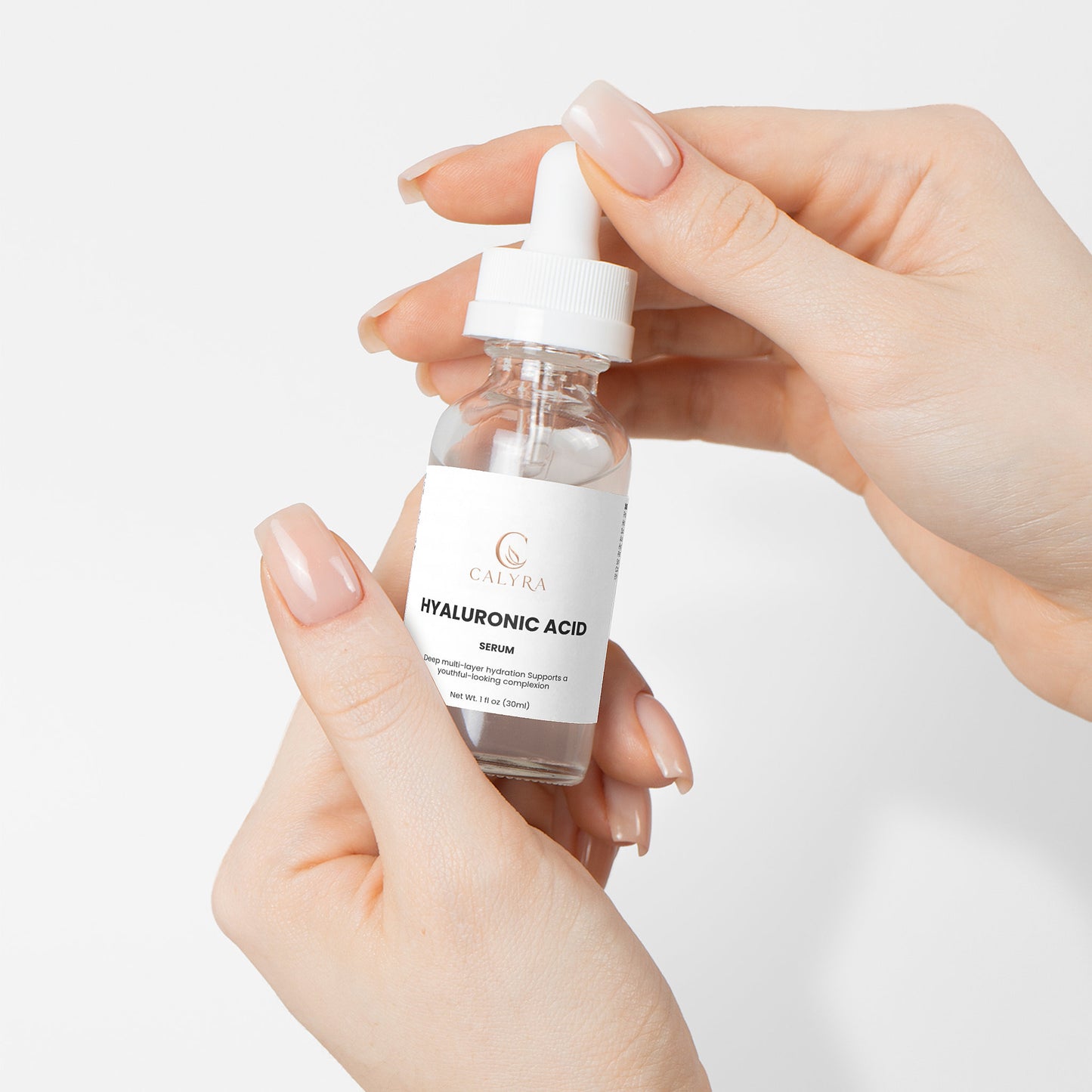
Hyaluronic Acid Serum
Help restore the look of a firmer, more defined complexion—so you look like yourself again.
Our COA
Our COA
OUR GMP Certificate
OUR GMP Certificate
Couldn't load pickup availability
"What if this doesn't work for me?"
Every person's skin is different.
That's why we never promise overnight transformations or unrealistic results.
What we do promise is a product designed to help support firmer, smoother, healthier-looking skin with consistent use—backed by our 60-Day Feel Like Yourself Guarantee.
"Maybe this is just aging... and I have to accept it."
One of the hardest parts isn't seeing your face change.
It's wondering if there's nothing you can do about it.
Many women tell themselves they should "just accept it," even though they don't feel ready to let go of the woman they still feel like inside.
You don't have to chase perfection.
You don't have to chase youth.
You deserve to care for your skin if it helps you feel more like yourself again.
"What if it's too late for me?"
This is one of the quietest fears women carry.
"I should have started years ago."
"I've waited too long."
"The damage is probably permanent."
The truth is, every woman's skin is different.
While no skincare product can promise to reverse years of aging, supporting your skin today is always a better choice than wishing you'd started tomorrow.
The best time to care for your skin is the time you decide you're worth caring for.
"I'm not trying to look younger."
You're not trying to become someone else.
You're not trying to erase every line.
You're trying to recognize yourself again.
The woman who smiled without worrying about her jawline.
The woman who didn't avoid photos.
The woman who looked in the mirror and immediately felt like herself.
That's the feeling Calyra was created to support.
"I don't want to look fake."
Neither do we.
The women who choose Calyra aren't chasing an artificial look.
They don't want people asking what they've had done.
They simply want to hear,
"You look well."
"You look refreshed."
"You look like yourself."
Sometimes that's all the confidence they were hoping to get back.
"I'm afraid of getting my hopes up again."
This may be the hardest one of all.
Because disappointment hurts more than wrinkles.
After trying product after product, it's easier to expect nothing than to hope again.
That's why we don't promise miracles.
We don't promise you'll wake up looking twenty years younger.
We simply promise to give you the time to see whether Calyra is right for you—with a 60-Day Feel Like Yourself Guarantee and an additional 15 days to make your decision.
Trying again shouldn't feel like another gamble.
"I'll just switch to a different coffee"
The problem isn't the coffee brand, the roast, or the brewing method. Every cup of regular coffee floods your system with caffeine all at once, triggering the same adenosine backlog and the same hormonal spike. Switching brands is rearranging the problem, not solving it.

Here's How Calyra Arrives at Your Doorstep
Made in the USA, at a CGMP-certified facility. Every batch is third-party tested with a Certificate of Analysis, so what's on the label is exactly what's in the jar — Purified Water, DMAE, Hyaluronic Acid, CoQ10, Aloe Vera Extract, Vitamin E Oil, Avocado Oil, Rheosol, Almond Oil, Phenonip, and Rosemary Extract.
Here's what happens after you order:
Verified quality — every batch comes with a third-party Certificate of Analysis
Fulfilled in 3–5 business days — your order is prepared and shipped promptly
Free shipping — anywhere in the United States, no minimum required
Protective packaging — packed to preserve freshness in transit
Tracking sent immediately — you'll know the moment it's on its way
Verified quality. Delivered free.
Your Face Is Losing It's Scaffolding.
Your face is held up by three things: fat pads in specific positions, ligaments anchoring everything to bone, and collagen giving structure to it all. As you age, all three fail together — fat shifts and slides lower, ligaments weaken, collagen breaks down. Skin doesn't tighten because there's nothing solid left to hold it up.
If you're past menopause, this accelerates fast. Roughly a third of your skin's collagen disappears in the first five years after — which is why your face may have felt like it "suddenly" changed, not slowly aged.
Lost significant weight? Same mechanism, different trigger. Facial fat empties out first, taking the support structure with it. That's the real story behind "Ozempic face" — it's not that weight loss ages you, it's that it removes the volume that was hiding structural aging you already had.
This is why nothing you've tried fully worked. Creams treat the surface. Microcurrent gives temporary tone. Energy devices tighten skin a little. None of them rebuild shifted fat, restore weakened ligaments, or reposition descended tissue — because that's not what they're built to do.
Even dermatologists say it plainly: surgical repositioning works differently than tightening, because it addresses what actually moved — not what's sitting on top of it.
You don't need tighter skin. You need to know what actually shifted.
You've Built the Whole Routine. Here's Why It's Still Not Enough.
Your cabinet probably tells the story: tretinoin, a neck cream, maybe a NuFACE in a drawer. A consultation or two — Botox, filler, someone mentioned Ultherapy. You didn't jump in blind. You built it up, hoping the combination would finally add up to something.
Some of it did a little. But the jawline's still soft. The jowls are still there. And you're left wondering if you just haven't found the right combination — or if you've been solving the wrong problem.
Here's what nobody tells you: you were never missing a step. You were missing a diagnosis.
Every product assumes something different is wrong. Cream assumes it's texture. Microcurrent assumes it's tone. RF assumes it's collagen. Filler assumes it's volume. None of them ask which one is actually yours — which is often several at once, and why stacking half-fixes rarely adds up to a full one.
What you need isn't another product. It's clarity on what's really happening, paired with something honest about what it can actually fix.
| Calyra skin firming cream | Basic face creams | Microcurrent devices | Energy-based devices | |
|---|---|---|---|---|
| Addresses skin hydration and tone | Yes | Partial | Partial | Limited |
| Addresses collagen support | Yes | Minimal | No | Some (variable) |
| Immediate visible effect | Yes | Minimal | Yes (temporary) | No |
| Long-term structural rebuilding | No — and we tell you that upfront | No | No | Limited |
| Cost | Low | Low | $250–$595 | $2,000–$3,300+ |
| Downtime or pain | None | None | None | Some pain, some downtime |
| Honest about what it can't fix | Always stated | Rarely stated | Rarely stated | Rarely stated |
| Ongoing maintenance required | Yes, daily use | Yes | Yes, high | Yes, sessions |
Here's How Calyra Works
DMAE is the ingredient most associated with a firmer, more toned look — which is why it's the core of this formula, applied specifically to the neck, jawline, and lip area, where you feel the loss of definition most.
Hyaluronic acid binds moisture into the skin, so it feels replenished and smooth rather than thin and crepey — the texture change that so often makes sagging look worse than it is.
CoQ10 supports your skin's natural regeneration process as an antioxidant, helping maintain vitality in skin that's already working harder to keep up with declining collagen production, especially post-menopause.
Used consistently on the face, neck, jawline, under-eye area, and lips, people using this cream report a more refined, toned, and hydrated look — skin that feels firmer and appears more supple, without claiming to change its underlying structure.
* Easy To Understand Summarised Scientific Studies
The Science Behind The Ingredients In Calyra
-
DMAE
The ingredient behind a firmer, more toned look
DMAE is one of the most studied ingredients in cosmetic skincare for supporting the skin's appearance of firmness. Applied consistently, it's included in this formula specifically to help skin look more toned and lifted — which is why it's the lead ingredient for the areas you notice sagging first: the jawline, the neck, and around the lips.
-
Hyaluronic Acid
The ingredient that gives skin back its bounce
Skin that's lost hydration reads as tired, thin, and crepey — often making sagging look worse than it actually is. Hyaluronic acid binds moisture directly into the skin, helping it feel replenished and smooth rather than dry and fragile. It's the ingredient responsible for that immediate feeling of "plumped" and hydrated skin after application.
-
Coenzyme Q10 (CoQ10)
The antioxidant that supports skin's natural renewal
As skin ages, it produces less of its own CoQ10 — and has to work harder to regenerate and defend itself against daily stress. Added to this formula for its antioxidant properties, CoQ10 helps support that natural renewal process, contributing to skin that looks more vital and less fatigued over time.
Feel The Difference — Or Get Your Money Back
Try Calyra™ for 60 days.
If you don't notice an improvement within 60 days, contact us for a full refund — no questions asked.
Still unsure after 60 days? You'll get an extra 15 days to decide if Calyra™ is right for you.
And if you experience any discomfort or unwanted side effects, stop use and contact our support team for a full refund.
You keep the jar either way.
From The Founder
Founder's note
My name is Liam Koulahi. I'm 24, based in Culver City, California.
I built Calyra because of my mom.
I watched her go through it — that sudden shift in her late 40s where she said her face just didn't look like "her" anymore. Not wrinkles. The lower half of her face: jawline blurring, heaviness under the chin, a bad photo or video call ruining her whole day. She tried creams, microcurrent, a couple of in-office treatments. Some helped a little. None felt like enough. And every consultation gave her a different answer, which left her more confused, not less.
What got to me wasn't the sagging. It was watching her stop feeling like herself.
So I looked into the actual science, not the marketing version. Turns out it's rarely just "loose skin" — it's declining collagen, thinning skin, and structural changes that accelerate hard after menopause. Most products address a sliver of that and get sold like they fix all of it.
I built Calyra to be honest from the start — formulated around what a topical can genuinely support, using ingredients with real evidence behind them. Built for women who feel exactly like my mom did: not ready for surgery, tired of guessing, done being sold miracles that don't hold up.
I built it for her. I know she isn't the only one.
Liam Koulahi
Founder, Calyra
FAQ
Is this just loose skin, or is something else going on?
Usually more than loose skin. Sagging in the lower face is typically a mix of things: declining collagen, thinner skin, weakened support structures, and shifting fat compartments. That's why "just tightening" often doesn't feel like enough — the skin is one part of a bigger picture.
Why haven't creams or devices worked for me before?
Because most of them were only ever built to address one layer of the problem. A cream can improve texture and hydration. Microcurrent can give a temporary sense of tone. But if what's really happening is deeper — volume loss or structural shifting — those tools were never going to fully solve it on their own. That's not a failure on your part.
Is this "Ozempic face" or is it just aging?
Often both, and they overlap. Significant or rapid weight loss empties facial fat pads that were providing support, which can make structural changes that were already happening become visible all at once. Menopause accelerates the same process from a different angle — a sharp drop in collagen production.
Why did my face seem to change so suddenly?
Collagen decline speeds up significantly around menopause — roughly a third of it can be lost in the first five years. That's the biological reason behind the "sudden" shift so many women describe somewhere between 46 and 52.
Will this cream give me the same results as Ultherapy or a facelift?
No, and we won't tell you it will. Surgical and energy-based procedures work on deeper tissue in ways a topical cream can't. What this cream can do is support skin quality — hydration, tone, and firmness — which is a real and meaningful part of the picture, just not all of it.
How is Calyra different from other creams that promise "lifting"?
We're upfront about what a topical can and can't do. DMAE, hyaluronic acid, and CoQ10 are included because they genuinely support tone, hydration, and skin vitality — not because we're implying they'll restructure your face.
How long until I see results?
Most people notice improved hydration and a smoother feel fairly quickly. Firmness and tone typically build with consistent use over several weeks, since that's how skin genuinely responds to ingredients like these — not overnight, and not from a single application.
Where do I apply it?
Face, neck, jawline, and directly on the lips or above the lip — anywhere you want a firmer, more lifted feel.
Is it safe for sensitive skin?
It's formulated for external use with recognized cosmetic ingredients. As with any new product, discontinue use if irritation develops, and avoid the eye area (if it gets in your eyes, flush thoroughly with water).
Do I need to combine this with other treatments?
Not necessarily. If your main concern is skin quality, hydration, and tone, this may be all you need. If a consultation or your own research points to more significant structural descent, we'll be honest that this cream supports skin health but isn't a substitute for a procedure that addresses tissue position directly.